
The American Psychiatric Association
Functions of the APA
Letter to the APA
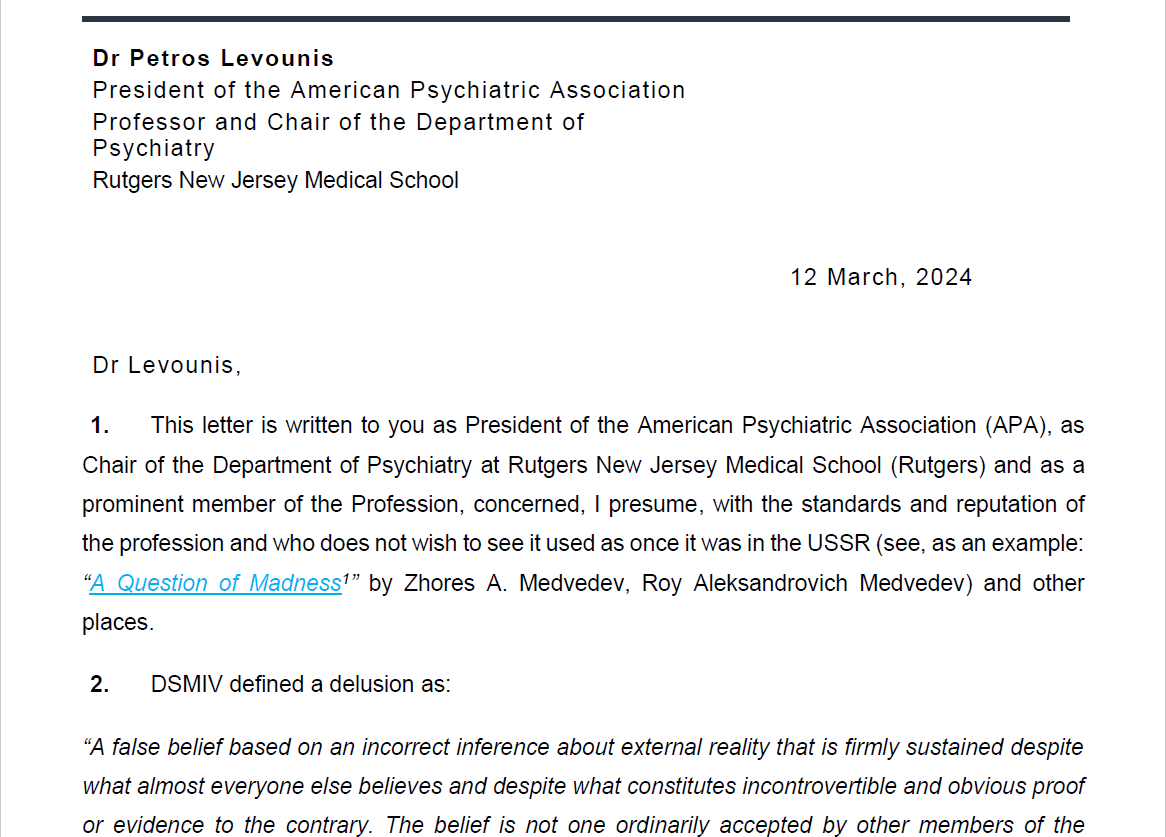
Communications with the American Psychiatric Association
1. The Diagnostic and Statistical Manual of Mental Disorders
(DSM), published by the American Psychiatric Association
(APA) defines mental disorders. Along with the International Classification of Diseases
(ICD), which is produced by the World Health Organisation, it
is the authority for diagnosing psychiatric disorders.
2. ICD does not try to define a delusion: its guidance appears to assume a delusion has already been
diagnosed.
3. The fourth volume of DSM (DSM-IV) defined a delusion as:
"A false belief based on an incorrect inference about external reality that is firmly sustained despite what
almost everyone else believes and despite what constitutes incontrovertible and obvious proof or evidence to
the contrary. The belief is not one ordinarily accepted by other members of the person's culture or
subculture (e.g. not an article of religious faith)."
4. The fifth volume of DSM (DSM-V) defines a delusion as:
"Delusions are fixed beliefs that are not amenable to change in light of conflicting evidence."
5. The Definition of DSM-IV was carefully drafted, with due attention to freedom of thought and to
preventing the abuse of psychiatry.
6. The problem with the definition in DSM-V is it replaces a clear and objective standard with one that
is nebulous and subjective: should we declare a person to be delusional, simply because he rejects conflicting
evidence we put before him?
(i). I wrote to Professor Levounis, President of the APA, asking if the definition of DSM-V rejected
the standards of DSM-IV or built on them (letter to the APA, above this text).
(a). I pointed out the dangers of the DSM-V definition, if taken strictly as it stands in that text,
including that it could be used by openly oppressive systems to section people who express views deemed undesirable
by the system. Such diagnoses would meet the standards of DSM-V and would bear the stamp of the American Psychiatric
Association.
(b). While it stands by the definition of DSM-V, even the APA would be unable reasonably to declare such
actions to be medical malpractice.
(ii). Mr Levounis returned no response to my letters.
7. On its YouTube channel
and in other material, the APA tries to explain its work in videos similar to that at the top of this page, yet it
refused to answer my questions: to explain its work to a person affected directly by it.
We encourage you to approach the people and organisations mentioned on this website and to request their response. We suggest you follow our guidance in doing so.
You may contact us directly.
